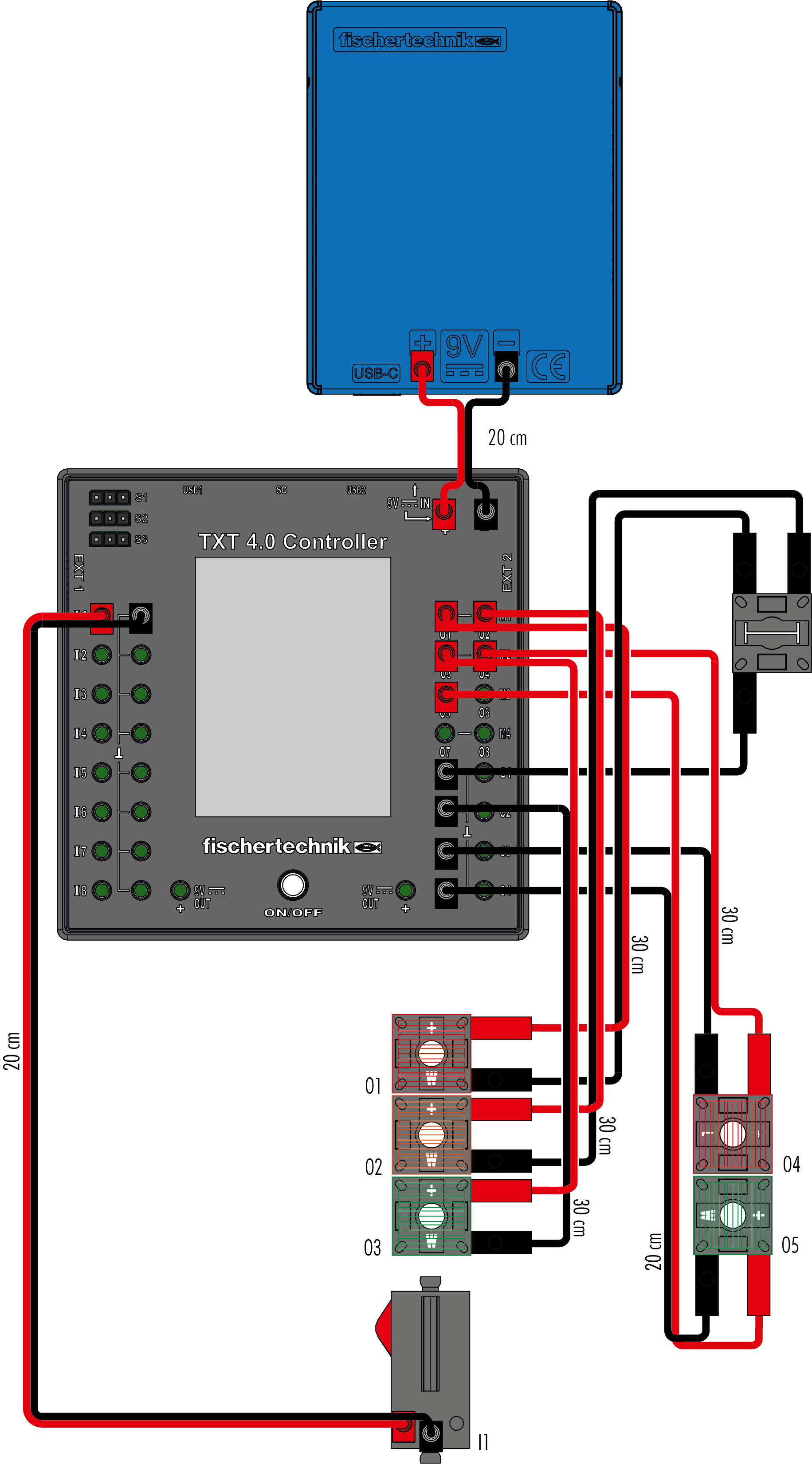
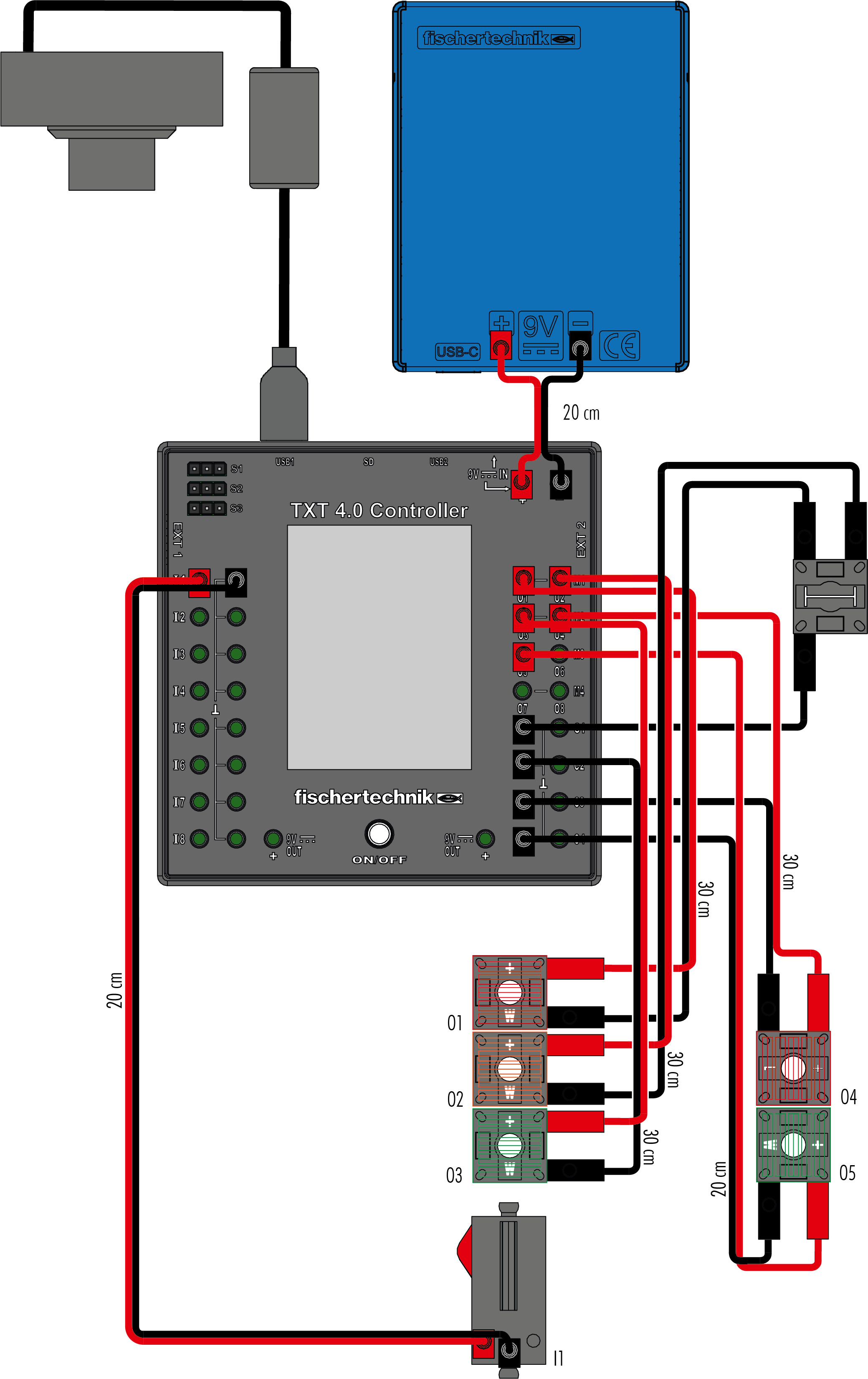
Models 6 & 7: Traffic light control

Is the traffic flowing?

Classifying
11-13
Duration Time
2 double hours per learning unit (extendable to 10 DS)
Difficulty level
Model: easy, programming: light to heavy
Model Types
Bench model for light signal system

MODEL DESCRIPTION/TASK

The pupils (SuS) plan and implement a light signal system for controlling passenger and motor vehicle traffic. Starting with a simple time-controlled pedestrian traffic light, via a crossing traffic light for a motorway to an intersection with motor vehicle and pedestrian flows as well as the AI phase control of a crossing traffic light, the model is evolving and thus also the requirements for design and programming. 

The SuS learn and read signal position plans and signal times plans. From the information in the signal timetables, they determine possible switching groups that can be switched at the same time, as well as the associated switching times.

The SuS develops a control program from the groups and times defined in this way, which can be tested for suitability using the traffic light model.

EVERYDAY COVERAGE

The time-controlled activation of actuators is familiar to SuS from technical science lessons or computer science lessons or their everyday life. In particular, embedding in a realistic application context, which the SuS are very familiar with from their everyday work, shows a
high level of motivation.

The topic could be integrated into the professional orientation with regard to traffic or electrical technical professional fields, where automated actuation of actuators is used in many areas. In particular, automated time control is used not only in industry, but also in the home environment, e.g. in smart home applications.

Key Questions

  • What types of traffic flow control are there? (Communication)
  • How can traffic flows of motorised traffic and pedestrians be controlled safely? (Collaboration)
  • What waiting times are reasonable for the individual road users?(critical thinking)
  • How can light signals be operated reliably on a time and request basis? (Creativity)

Compartment cover
​

Data Processing
Advanced programming, condition loops, functions, graphical displays, neural networks, AI
Mathematical
Calculation of terms
Technology
Stable construction, signal timetables, construction technology
Physics
Circuit, movement, measurements of times

Course History
​

Start-up phase
Planning phase
Light signal system design phase (traffic light control 1)
Programming phase of the traffic signal system (traffic light control 1)
Experimentation and test phase of the light signal system (traffic light control 1)
Conclusion/connection phase of the light signal system (traffic light control 1)
Design phase of the traffic intersection (traffic light control 2)
Intersection programming phase (traffic light control 2)
Experimentation and test phase of the traffic intersection (traffic light control 2)
Conclusion/connection phase of the traffic intersection (traffic light control 2)
Design phase of the AI phase control (traffic light control 3)
Programming phase of the IC phase control (traffic light control 3)
Experimentation and test phase of AI phase control (traffic light control 3)
Completion/connection phase of the AI phase control (traffic light control 3)

 Notes and information

​

Methodological and didactic notes
​

Differentiation options

Depending on the duration of the lesson series and the strength of the SuS,

  • the complexity of the requirements for controlling the signal controls is increased not only by the number of light signals, but also by the number of traffic flows to be crossed safely. 
  • a real measurement of the signal times of a SC in the school environment, which could form the basis for a modified SC control.
  • the traffic light model can be expanded by group work. 
  • the USB camera can be used to detect road users and, as a result, adapt the phase lengths due to changed clearing times.
    ​

Motivational aspects

The topic of automatic control of actuators is familiar to all SuS from everyday life. 
Numerous smart applications have long been part of everyday life in many households. Time-controlled autonomously switching washing or dishwashers, centrally controlled roller shutters or semi-autonomous cooking machines are increasingly being used.


Supplementary materials

  • If available, a video could be used for the introduction phase to the topic.
  • Drawing media (paper, whiteboard or projection surface).
    ​

Functions of the model and their technical solutions
​


Functions of the sensors/actuators


Technical solution

 
Light signal system (LSA)


Actuator timing


Request notification

 Adaptation of programming


Crossing simulation


Unbundling traffic flows

Colour recognition by USB camera Control of green phase lengths
Traffic light control 2:
Connection of two TXT 4.0 controllers
Data exchange between two controllers
according to the master and slave concept 

Traffic light control 3:
Colour recognition by USB camera
  • Building a neural network 
  • Recording of training data 
  • Implementation of a classification problem using AI
Further differentiation:
Adaptation of the SC to actual SCs
Data collection, modelling, phasing, 
Programming, testing

Bill of Materials
​


Sensors


Function


1 On/Off button on the TXT 4.0 controller


Switching on the traffic light control


1 mini button

Request notification

1 USB camera Categorisation of road users 


Actuator


Function

1 TXT 4.0 controller display

Visualisation of the program 
5 LEDs (2 × red, 2 × green, 1 × yellow) Traffic light signals 


cd-blue-7b46469956-wr69s