Introduction to industrial robots
Industrial robots have become an integral part of the modern manufacturing industry. They are mostly used in factories to carry out repetitive tasks quickly and with high precision. In this introduction, we will look at their structure and basic functionality. We take a look at the history of their development and find out why industrial robots have become indispensable in many industries today.
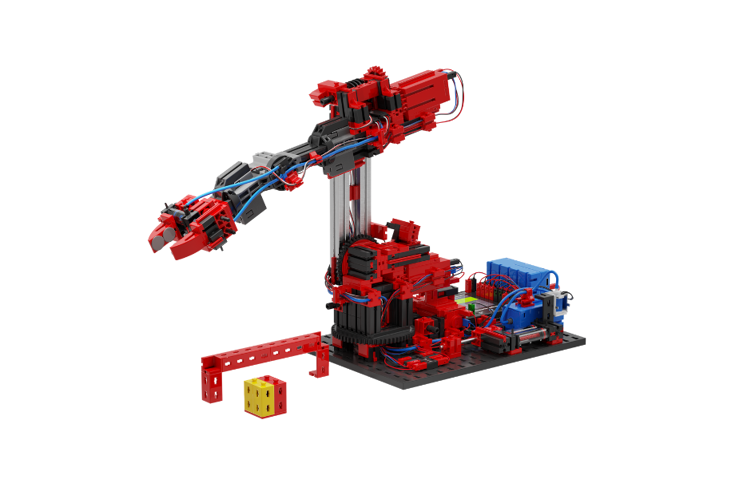
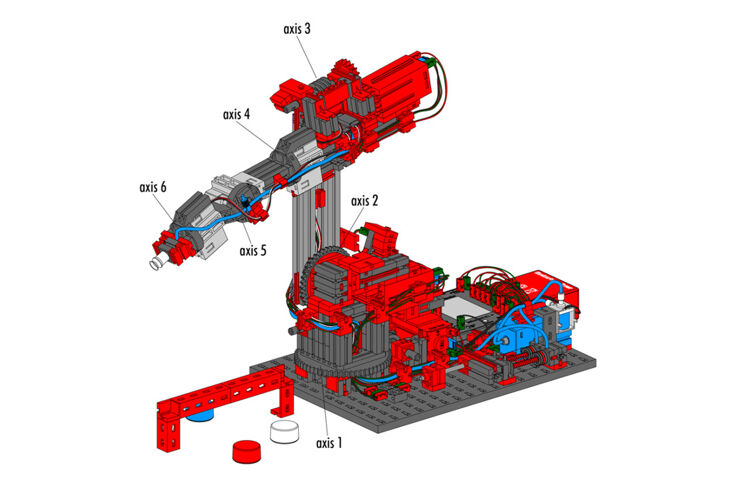
Industrial robots consist of a robot arm that has various joints. A simple movement for us humans requires highly complex programming and control of multiple axes in a robot. Basically, the number and arrangement of the joints can vary depending on the robot model. However, the most common are articulated robots with six axes or degrees of freedom. The number of degrees of freedom indicates over how many independent movement possibilities the robot arm has. With six degrees of freedom, the robot can reach any point in space with any orientation. Reaching the point requires three degrees of freedom (namely the x, y, and z coordinates) and reaching any orientation requires three additional degrees of freedom (namely tilting in the x, y, and z directions). We will also get to know the structure and programming of such a 6-axis robot in this modular system.
In addition, there are numerous other designs of industrial robots for special applications, such as the very fast-moving SCARA robots and delta robots or cable robots for particularly large work areas.

The joints of an industrial robot are usually driven by powerful electric motors, as industrial robots often lift heavy components or tools. The current position of each individual joint is recorded via a position measuring system, and a special control system drives the electric motors so that the robot moves to the desired target point at the desired speed. In addition, industrial robots are equipped with a variety of sensors so that they can perceive their environment and perform their tasks safely and precisely. Depending on the application, cameras, tactile sensors, force sensors, or distance measurement sensors are used.
At the end of the robot arm is the tool, which can vary depending on the application:
Moving components: Mechanical grippers, vacuum grippers
Joining components: Punching pliers, welding pliers, glue gun
Assembly: Screwdriver
Measuring components: Laser measuring system, camera

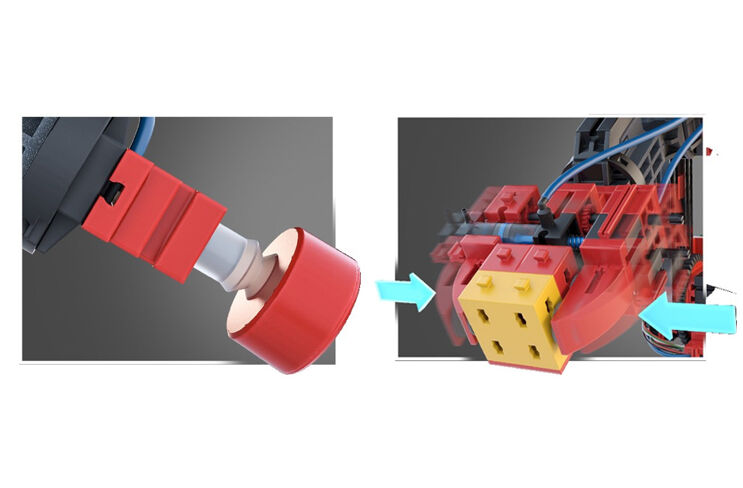
Some robots are even capable of automatically and independently changing their tools. To supply the tools with energy, industrial robots typically provide electrical connections or a connection to the compressed air system. The modular industrial robot is equipped with a vacuum gripper and can also be converted to a pneumatic gripper.
Depending on the specific application, industrial robots can perform various movements, from linear movements to rotational movements and complex motion patterns. The so-called path, i.e., the position of the tool over time, as well as the speed, are determined during the programming of the robot.
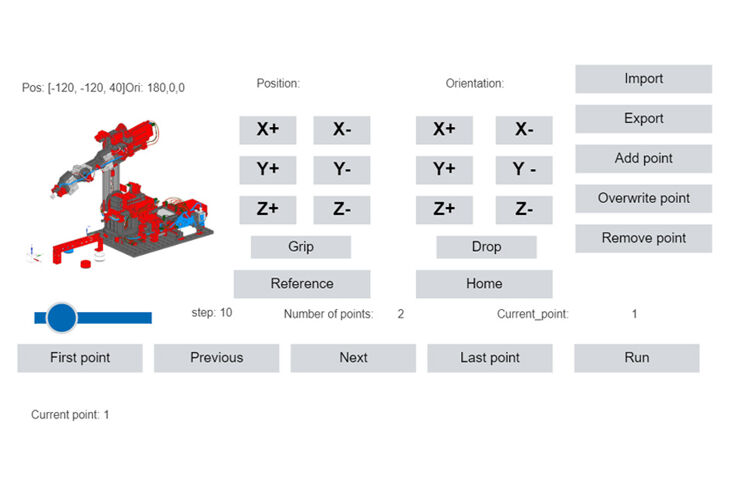
Industrial robots are controlled by pre-programmed instructions called robot programs. These programs are developed by technicians and engineers and contain a sequence of commands that control the robot arm and other components. Programming can be done on various logical levels: In low-level languages such as G-code, the individual target coordinates are programmed, which the robot moves to one after another. Teach-in-programming simplifies robot programming by having an operator first move the robot to the desired positions using a remote control and save each position („teach“). Afterwards, the robot can independently repeat the learned sequences of positions. With modern software, industrial robots can also be simulated and programmed in a virtual environment, and the program can be loaded onto the robot later. This so-called offline programming offers the advantage that the robot can perform another task simultaneously and thus remain productive. In this accompanying material, we will learn the individual steps from controlling a single axis to teach-in programming.

Industrial robots are used in a wide variety of designs in many areas:
Let’s summarize the reasons why industrial robots have become indispensable in so many industries today:
Before industrial robots became an indispensable part of a modern factory today, we look back on a 70-year development history.
The birth of industrial robots dates back to the 1950s, when George Devol and Joseph Engelberger founded the world’s first robotics company „Unimation“ and developed the first industrial robot called „Unimate". Unimate was used in 1961 in an automobile factory in the USA to remove and separate injection-molded parts. With this breakthrough, Unimate revolutionized automobile manufacturing and opened up new possibilities for automating production processes.
In the following decades, industrial robots were continuously further developed and used worldwide. In the 1970s, more advanced control systems based on microprocessors emerged, which still form the basis of modern robot control today. During the 1980s, industrial robots became more flexible and have since been able to perform a variety of tasks such as assembly, painting, and material handling.
With technological progress, industrial robots have become increasingly intelligent and powerful. Advanced programming options enable them to perform more complex tasks and adapt to changing production requirements. The further development of industrial robots is driven in particular by the use of advanced sensors for environmental perception and artificial intelligence.
The research field of human-robot collaboration deals with the question of how robots can safely work together with humans. While industrial robots have so far mostly operated in fenced-off areas, the use of touch-sensitive sensors and cameras aims to reduce the distance to their human colleagues. Workplace safety naturally has the highest priority.
Another research area deals with the question of how industrial robots can learn movement independently and become less dependent on fixed programmed patterns. Despite their superiority in terms of speed, precision, and reliability, industrial robots so far rely on an exact programming of the movement sequence and therefore fail at seemingly everyday problems for which they have no program. A well-known example is the "grasp into the box," where a robot with a gripper must pick arbitrary objects out of a box.
How does the robot recognize where the individual objects are located without the positions being pre-programmed?
How can the robot securely grasp the objects without dropping them when lifting?
How strongly may the gripper be squeezed without damaging the object?
A human would solve these tasks with their sensitive hands as well as intuition and experience. Researchers want to transfer this principle to industrial robots: For this purpose, they investigate how robots can perceive their environment and respond to changing requirements using additional sensors and artificial intelligence. This is intended to make industrial robots even smarter in the future and enable them to independently handle complex tasks.
For a comprehensive understanding and a rigorous mathematical derivation of the concepts for control and regulation (at university level), the following are suitable:
Weber, Wolfgang; Koch, Heiko: Industrial Robots. Methods of Control and Regulation. Carl Hanser Verlag Munich. 2022.