Time required
Introduction to the topic
An AI is simply understood as a program that behaves intelligently in some way. Depending on the task, it can be about recognizing images, translating texts, or perhaps generating music.
There are many different types of AIs. Nowadays, however, when we talk about AIs, we mostly mean so-called artificial neural networks. These are, simply put, replicas of structures like those in our brains. Neurons are cells that are connected to other neurons, and together with the other neurons, these networks can learn.
For the different tasks an AI is supposed to perform, there are different types of such networks – our language center works somewhat differently than our visual memory. It is the same with AIs. There are also different types of networks, and depending on the task, the appropriate networks must be used.
How does a neural network work?
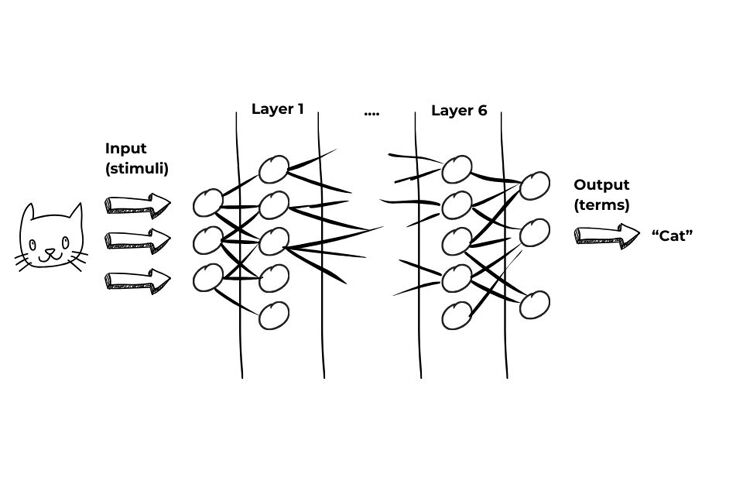
The following illustration describes the basic structure of a network.

On the left side (input layer), the signals arrive – this is comparable to our sensory cells. The sensory cells are connected to neurons, and the strength of the connection indicates how strongly a neuron responds to the stimuli from the left.
On the right side (output layer), we see the output neurons – simply put, these represent certain concepts perceived by the senses on the left side. For example, if we "see" an image on the left, the term "cat" might be associated on the right.
Between the sensory cells on the left and the output neurons on the right are structures made up of many neurons. These are usually arranged in individual "layers," and each layer has a specific task or function.
The division of nodes in an artificial neural network into layers serves clarity. These are called the input layer, hidden layer, and output layer.
For different tasks, there are different types of connections. Certain connections are well suited to recognizing parts of images, while others are good at recognizing temporal sequences like words in sentences.
Terms like Deep Learning, Deep Mind, or the program DeepL, which translates text into another language, refer to the structure of the neural network – to a so-called "deep" network. The "deep" simply means that there are many layers in sequence, with each layer responding to the outputs of the previous one.
Learning in a neural network works, simply put, by inputting stimuli, e.g. images, on the left side and then checking whether the correct term appears on the right side. If this is not the case, the strength of the connections is adjusted from right to left and the process is repeated until the network responds correctly.
The constant computation of a large network is very complex. Therefore, AI tasks are trained on the PC and not on the TXT 4.0.
Artificial intelligence has been worked on for many decades. However, for a long time, computers and networks were not powerful enough to train larger neural networks. To train a network from scratch so that it can recognize objects, millions of images are needed, for which the network must be constantly computed from left to right and then corrected again from right to left.
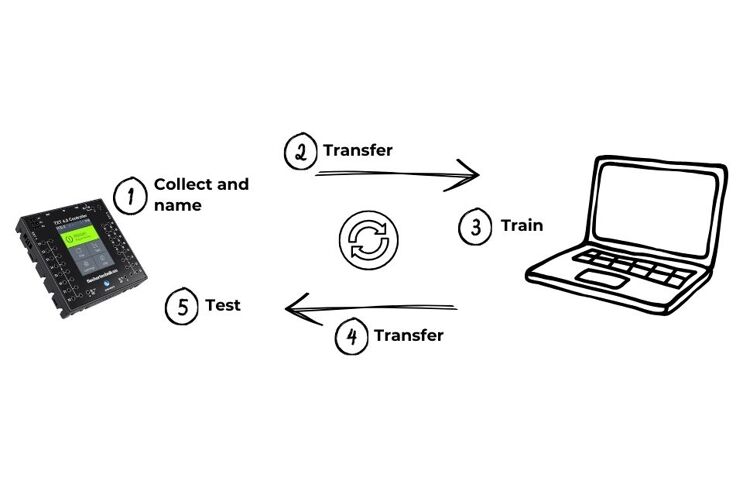
For an AI to do anything, it must first learn and then later apply what it has learned. The basic principle always follows these three steps:
We will quickly realize that training is not that simple. It requires the right images, enough of them, and the lighting conditions must also be correct. But this is something to be discovered through researching and experimenting with the models themselves.
To make training the AI less difficult, we use a pre-trained AI as a basis for our examples. This AI is capable of recognizing objects and only needs to be taught the "names" of the things it should recognize. This type of learning is called transfer learning.
In our experiments with the TXT, we always proceed as follows: We use the model to collect images for learning. For this, we need to write a program that captures images and sorts them into groups
Although the TXT 4.0 is a very powerful controller, training an AI requires a bit more computing power. Therefore, we transfer the data to a PC or laptop and perform the training there. After a few minutes, the trained AI model can be transferred back to the TXT.
Now we can use the AI on the TXT with another program.

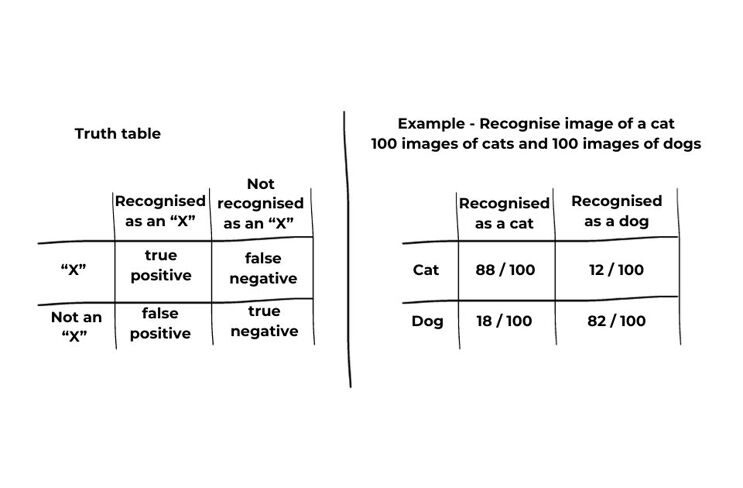
To evaluate how well an AI recognizes objects, a so-called confusion matrix is typically used. For this, the AI is shown only objects of one type, and the number of correctly recognized objects is counted. These are the so-called "true positives." Objects that are incorrectly not recognized are referred to as "false negatives."
Both numbers are divided by the total number of objects shown, resulting in a ratio value.
The closer the first two values are to 1 and the second two values are to 0, the more reliably your AI correctly recognizes the objects.

The development of AI in recent years is fascinating and unprecedented. From self-driving cars, speech recognition, movie recommendations on video streaming platforms to personalized advertisements, AI has found applications in almost every area of our lives.
As early as 1726, Jonathan Swift described in his novel "Gulliver's Travels" a computer-like machine called the "Engine," which was used to expand knowledge and improve mechanical processes.
However, the 1950s are actually considered the decade in which the first significant breakthroughs in the possibilities of creating intelligent machines were achieved.
At the end of the 1960s, the program "ELIZA" was developed (Joseph Weizenbaum), a kind of chatbot that was first tested in a simulated doctor-patient conversation. Later, the insights from ELIZA were incorporated into so-called "expert systems." Edward H. Shortliffe developed MYCIN, an expert system designed to support doctors' diagnostic decisions.
There were also developments in the 1980s that contributed to shaping the future of AI. In 1984, a milestone was reached with the development of the robot RB5X. Its self-learning software enables the prediction of future events based on historical data. NETtalk 1986 (Terrence Joseph Sejnowski, Charles Rosenberg) was one of the first programs to use artificial neural networks. NETtalk can read words and pronounce them correctly as well as apply what it has learned to words unknown to it.
In the 1990s, the first algorithms were developed that enabled systems to automatically make decisions and solve problems by accessing stored data and information. In 1997, the AI chess machine "Deep Blue" from IBM defeated the reigning world chess champion Garry Kasparov in a tournament. This is considered a historic success for machines in a field previously dominated by humans. However, critics argue that "Deep Blue" won not through cognitive intelligence but merely by calculating all possible moves.
In 2016, the system "AlphaGo" defeated Lee Sedol from South Korea, one of the world's best Go players. Technological leaps in hardware and software are paving the way for artificial intelligence in our daily lives. In particular, voice assistants have become very popular: Apple's "Siri" was launched in 2011, Microsoft introduced the software "Cortana" in 2014, and Amazon presented Amazon Echo with the voice service "Alexa" in 2015. In the corporate environment, AI development is manifesting in the form of automation, deep learning, and the Internet of Things. In addition to industrial robots, more and more service robots are being developed.
2020 marked the beginning of a new decade for AI. OpenAI has developed a series of groundbreaking AI models in recent years, including GPT-3, GPT-4, DALL-E, and GLIDE. These models demonstrate that AI is capable of solving complex tasks such as text generation, software programming, and image processing.
Despite decades of research, the development of artificial intelligence is still relatively in its early stages. Possible measures to regulate AI are also increasingly becoming a topic of discussion. To be used in sensitive areas such as automated driving or medicine, it must become more reliable and safer against manipulation.
The AI Act of the European Union requires transparency for AI systems in many areas so that people can understand the way AI thinks.